

Greetings everyone!
I hope you are having a fabulous summer.
I just finished this piece about the Instinctive Center for my page about the seven centers. This center has often been a tough nut to crack for Michael students, and I decided to explore the topic in greater depth. What I discovered in my journey was genuinely surprising.
The subject may be a tad technical—think of it as the soul’s background operating system— but I know you’re up for the challenge.
Take a look—I hope you find it useful in your studies.
Peace,
Dave
The Instinctive Center
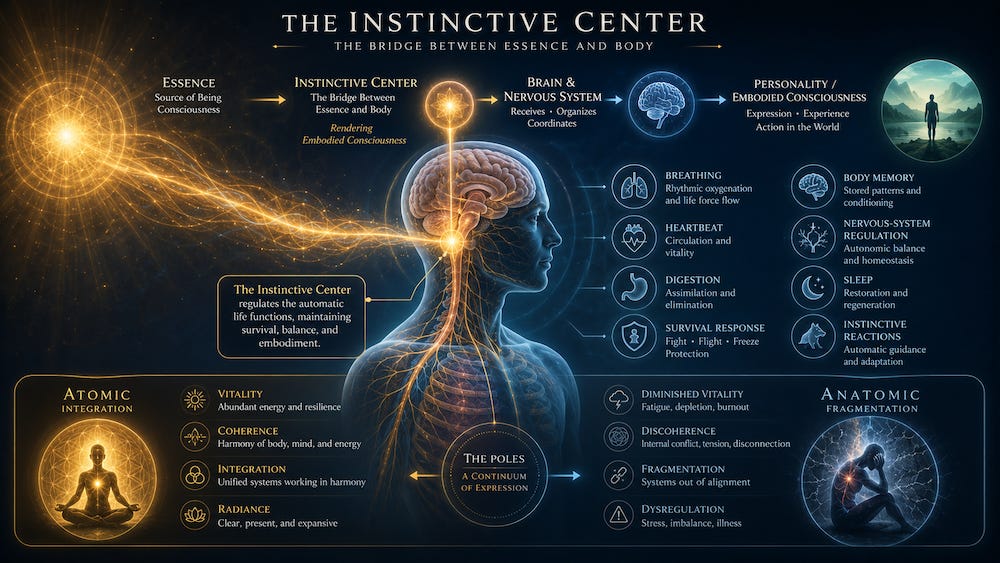
The instinctive center has not been generously written about in the Michael teachings, and its function has often remained enigmatic among Michael students. Unlike the other centers, the instinctive center operates in the background. It is not directly observable and its true nature has remained abstract.
Imagine the body as a house. The instinctive center would exist below the floorboards, intertwined with the plumbing, the electrical grid, and the very foundations that support the structure. The center regulates those automatic bodily processes that function beyond cognitive awareness, such as the heartbeat, breathing, digestion, the nervous system, and other automatic tasks that sustain life.
The instinctive center operates continuously as long as the body remains alive. Its relentless cadence, like an atomic clock embedded in the infrastructure, helps maintain synchronization in the body, including coordination with the other centers, until the last breath.
Consciousness may wander; the body keeps the hour.
What the Earlier Material Establishes
As first stated in the original books by Chelsea Quinn Yarbro, the instinctive center is the neutral center among the others. It energetically correlates with the role of Scholar on the assimilation axis.
Its positive pole is ATOMIC; Its negative pole, ANATOMIC.
Where the intellectual center champions thought and reason, in a true-or-false dichotomy; where the emotional center vacillates between like and dislike; where the moving center responds through action, the instinctive center is not driven by the same dualities but occupies neutral ground, a foundation for the other centers. Like an ancient monolith—the body’s version of Stonehenge, carved from Essence, not ego—the instinctive center remains beneath the weather systems of False Personality. It endures the passing of time to accomplish one thing: sustain the body—the temple through which Essence lives.
What the Instinctive Center Governs
The instinctive center governs all the things you don’t need to think about to stay alive.
● Heartbeat
● Respiration
● Blood circulation
● Digestion and metabolism
● The immune system
● Common reflexes
● General healing
Self-Preservation
When a hungry bear crashes through the door of your mountain cabin, the instinctive center launches the fight-or-flight response to avoid becoming dinner. With the slowly turning gears of the intellect and the paralyzing bouts of fear from the emotional center, the conscious mind cannot think fast enough in some life-or-death situations, and the instinctive center takes charge when quick action is imperative.
Cellular and Past Life Memory
Past life memories and trauma from past lives get stored into cellular memory, organized and maintained in the filing cabinets of the instinctive center. A fear of heights and other phobias stem from this center. Unresolved karma, waiting for an opportunity to be paid, maintains an active ledger there.
Can a Person Be Instinctively Centered?
Regarding personality, Yarbro claims it is extremely rare for Essence to choose the instinctive as a primary center. Sarah Chambers, one of the original Michael channels, went so far as to say that no sentient being is instinctively centered. Period.
Other channels have suggested that, although rare, there are instinctively centered people who are fully functional.
A useful maxim often applies here: When in doubt, trust in Yarbro.
Two points come to mind:
First, the instinctive center was never engineered to accommodate conscious participation. A sentient being would feel locked into the machinery, with mechanisms that don’t support deliberate and reflective conscious choice. Reactions are immediate in this center. Acts of thinking, feeling, and movement are overruled in favor of breathing, digestion, circulation, and other autonomic functions. In that environment, a sentient soul would feel as if they had wandered into a funhouse mirror at a dilapidated carnival. Disorienting, disturbing, and claustrophobic.
Like the other centers, the instinctive has the intellectual, emotional, and moving parts, but the parts of center are subdivisions of the primary center. They are not fully operating parts in their own right; the nature and influence of the primary center remain in force.
Yarbo conceeds that in exceedingly rare cases, feral children and s avants have occupied the instinctive center and tapped into the parts of center, but these are not functional people in the conventional sense.
Second, if someone has channeled the Instinctive Center for an individual, they may instead have been perceiving Physical centering. And there could be a reason for this beyond simple channeling error.
Consider the intervals between the notes of a diatonic musical scale. The interval between the third and fourth notes is a half-step rather than the whole steps found elsewhere in the scale. Ignoring, of course, the half-step that exists between the seventh tone as it reunites with the first note, an octave higher.
Whether the vibrational properties of a diatonic scale are universally applicable to the numbers in Michael math is open to debate. If they are, however, the Physical Center (3) and the Instinctive Center (4) may share an unusually close energetic relationship.
● The instinctive center maintains life.
● The physical center experiences that aliveness not that far removed.
With this degree of closeness, the instinctive and physical centers share adjacent levels of the same continuum
This may help explain the confusion between the two centers.
MICHAEL: To add commentary to what has already been established, we wish to mention three further points.
First, the instinctive center is not the same as the primary working centers (intellectual, emotional, moving). A personality rarely fixates in the instinctive center, and that is only if the personality cannot function normally with the other working centers, because of a congenital brain defect or other obstacle.
Second, the primary working centers are inherently wired to react and assist in the formation of individual choices. The instinctive center, by contrast, acts as the body’s security detail, responding immediately and decisively to anything that threatens survival.
Third, the instinctive center primarily functions much like a thermostat that operates continuously to maintain a state of equilibrium, making energetic adjustments where needed and metaphorically putting out fires in any regions of the body that require urgent attention.
Altogether, despite disparate parts in the body that work separately, the instinctive center works at all times to achieve a greater whole.
The Instinctive Center as the Infrastructure of Embodiment
A Recent Clarification
While the instinctive center has long been recognized as a center about instinct, survival, and habit, what had not been known is that a broader function exists where the instinctive center also serves as a mechanism that allows the consciousness of a soul to sustain itself in the body.
MICHAEL: It is true that essence provides the juice, or the electrical current, so to speak, that awakens consciousness in the brain. The brain functions from the instinctive center and governs all biological and electrical processes that keep the body alive.
The instinctive center plays a considerable role in coordinating the exchange between body and soul, and regulating the connection. The positive pole functions as a rendering instrument, ensuring that the coupling remains integrated in its vibrational merger. The negative pole is a less vibrant state when the body is overwhelmed with illness or other varieties of dysfunction or psychological malaise.
Further channeling expanded the mechanism:
MICHAEL: “The instinctive center acts as a conduit for the incoming soul and provides the infrastructure for both matter and spirit to align as an organism that could only exist on the physical plane in tandem.
That the positive pole of the instinctive center is labeled Atomic is no coincidence, and the term was given by design.
The subatomic particles of the body are the access point of the soul, and the instinctive center coordinates how the soul synchronizes with the neurological pathways of the brain.
It may be helpful to view the instinctive center, figuratively at least, as a hangar where commercial aircraft, following a long flight, return for system checks, repairs, and, if needed, complete overhauls. The instinctive center is like a maintenance shop that runs twenty-four hours a day in the body, not only to sustain the life of the body but also to maintain the continued embodiment of Essence.
Think of Essence as the chief architect and the instinctive center as the operations manager.
What was not revealed in the earlier channeling is the importance of the instinctive center in maintaining the integrity of matter and soul throughout a lifetime. The internal monads, for instance, act as markers within the life cycle, and while Essence is at the helm during this voyage, the instinctive center, relying on its internal navigation, releases buoys along the journey, synchronized with progress made on the life plan, that signal the next monadal transition.
The instinctive center is also a repository of data concerning the operational efficiency of the body—where its strengths lie and where its weaknesses may lead to roadside repairs. Essence uses that data to map the optimal trajectory of the life as it unfolds. Detours are frequent, and occasionally an unexpected dead end terminates the journey.
Taken together, these passages suggest that the instinctive center juggles more plates than originally thought. Ensuring the survival of the body, while of tremendous importance, is only one facet of this center. Coordinating the infrastructure that allows soul and matter to become embodied, like the alliance between violin and virtuoso, makes possible a life that is not only played into being but emerges as a unique art form: a human personality.
How Embodiment Occurs
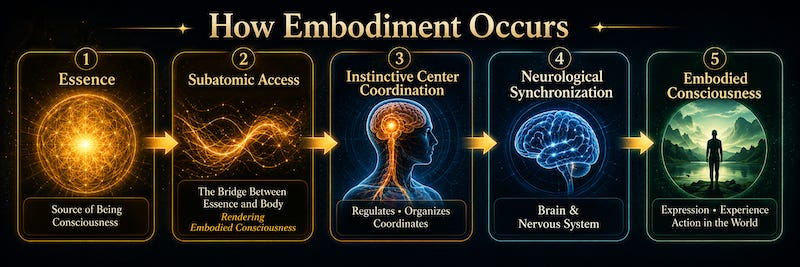
According to the new channeling, embodiment is not as simple as switching on a light in the brain. An act of coordination must occur to allow spirit and matter to align as a single living organism.
The subatomic structure of the body is the initial point of access. Essence engages with the body, but not so thoroughly that spirit becomes matter. The instinctive center acts as a coordinating mechanism, configuring the connection into a translatable form the nervous system can receive. (This is explained more comprehensively in an upcoming article, “How the Soul Inhabits the Body”)
From there, the incoming soul synchronizes with the neurological pathways of the brain. Essence acts as the animating catalyst that spawns the first state of consciousness in the body, and the instinctive center regulates and integrates the connection, tuning it to the body until both spirit and matter resonate as one.
Embodiment occurs at first breath.
The sequence follows this five-step trajectory:
➊ Essence ➋ Subatomic Access ➌ Instinctive Center Coordination ➍ Neurological Synchronization ➎ Embodied Consciousness
Imagine a steam locomotive chugging away from the station.
Essence represents the flames of potential in the firebox that power the engine. Subatomic access is where water converts to steam. The instinctive center is the boiler that regulates the force. Neurological synchronization occurs through the coordinated efforts of the pistons, valves, and drive rods. And embodied consciousness is the final result: steel wheels gripping the track, and the incarnational journey begins.
Atomic and Anatomic
At first glance, the positive and negative poles of the instinctive center look like a crib sheet for a quantum physics course. But rest easy. Schrödinger’s cat won’t make an appearance anywhere in this piece. The poles reveal the spectrum that exists between the atomic and anatomic, from integration and coordination to fragmentation and loss of homeostasis.
Atomic (Positive Pole)
The term Atomic, sometimes altered by other channels because it seemed vague, turned out to be surprisingly apt.
It’s operating system is twofold: One, to maintain a homeostatic state in the body, cohesive and elemental, where the energy driving the physical systems is unfettered and unified. Two, to coordinate an integration between body and soul until the organism is no longer viable.
An attainment of perfect health, however, is not a prerequisite for occupying the positive pole. A person can be ill and still remain integrated. In other words, the Atomic doesn’t prevent illness, but when available immune responses work together as a whole, they avoid the pitfall of systems being at cross-purposes.
Anatomic (Negative Pole)
In the Atomic pole, the systems of the body flow effortlessly, as if a superfluid coursed through the veins with zero viscosity and without wasted energy. In the Anatomic pole, the instinctive center is like an engine running out of oil. What once glided now grinds. The system becomes mechanical, with each part straining under the stress, the friction and heat causing the parts to fuse together until the engine begins to seize.
What once flowed as a whole is now fragmented. The organs in the body struggling under the strain of being less unified. This can be a temporary setback, caused by prolonged illness, exhaustion, trauma, psychological duress, or something neurological, but the body is resilient and often resets.
In more extreme cases, the systems of the body collapse and fail.
The great Plas Johnson has passed away, just shy of age 95. You know his big, brawny sound as the tenor sax from the Pink Panther theme.
Here’s his chart.
7th mature scholar, discarnate artisan ET, sage casting (5/7/2), acceptance, pragmatist, passion, moving/emotional, stubbornness/no secondary.
I’ve always loved this solo on his album called “The Blues.” Not a flurry of notes in search of a concept, but just one great swinging idea, chorus after chorus.
Interested in getting your own Michael chart? Order a chart today.
Until next time, thanks for reading!
All the best,
David Gregg
P.S. - As a reminder: If you value this work and wish to support it, please make a donation. Your help means the difference between these teachings continuing and going silent.